The weights and measurements used in commerce were crucial in ancient agricultural economies. The Bible urges the Jews to be fair in their dealings with one another (cf. Lev. 19:35-36; Deut. 25:13-16; Pro. 11:1; 16:11; 20:10). The real problems were not only honesty but also the non-standardized terms and systems used in Palestine. It seems that there were two sets of weights: a “light” and a “heavy” of each amount (see The Interpreter’s Dictionary of the Bible, vol. 4, p. 831). Additionally, the decimal system (base of 10) of Egypt had been combined with the sexagesimal (base of 6) of Mesopotamia.
Many of the “sizes” and “amounts” used were based on human body parts, animal loads, and farmer’s containers, none of which were standardized. Therefore, the charts are only estimations and are tentative. The easiest way to show weights and measures is on a relational chart.
I. Volume Terms Used Most Often
Log (BDB 528), cf. Lev. 14:10, 12, 15, 21, 24.
- Dry Measures
- Homer (BDB 330, possibly a “donkey-load,” BDB 331), e.g., Lev. 27:16; Hosea 3:2.
- Letekh (or Lethech, BDB 547, possibly alluded to in Hosea 3:2).
- Ephah (BDB 35), e.g., Exod. 16:36; Lev. 19:36; Ezek. 45:10-11, 13, 24.
- Se’ah (BDB 684), e.g., Gen. 18:6; 1 Sam. 25:18; 1 Kgs. 18:32; 2 Kgs. 7:1, 16, 18.
- Omer (BDB 771 II, possibly “a sheaf” [a row of fallen grain], BDB 771 I), e.g., Exod. 16:16, 22, 36; Lev. 23:10-15.
- Issaron (BDB 798, “a tenth part” of ephah), e.g., Exod. 29:40; Lev. 14:21; Num. 15:4; 28:5, 13.
- Qav (or Kab, BDB 866), cf. 2 Kgs. 6:25.
2. Liquid Measures
- Kor (BDB 499), e.g., Ezek. 45:14 (can be dry measure, cf. 2 Chr. 2:10; 27:5).
- Bath (BDB 144 II), e.g., 1 Kgs. 7:26, 38; 2 Chr. 2:10; 4:5; Isa. 5:10; Ezek. 45:10-11, 14.
- Hin (BDB 228), e.g., Exod. 29:40; Lev. 19:36; Ezek. 45:24.
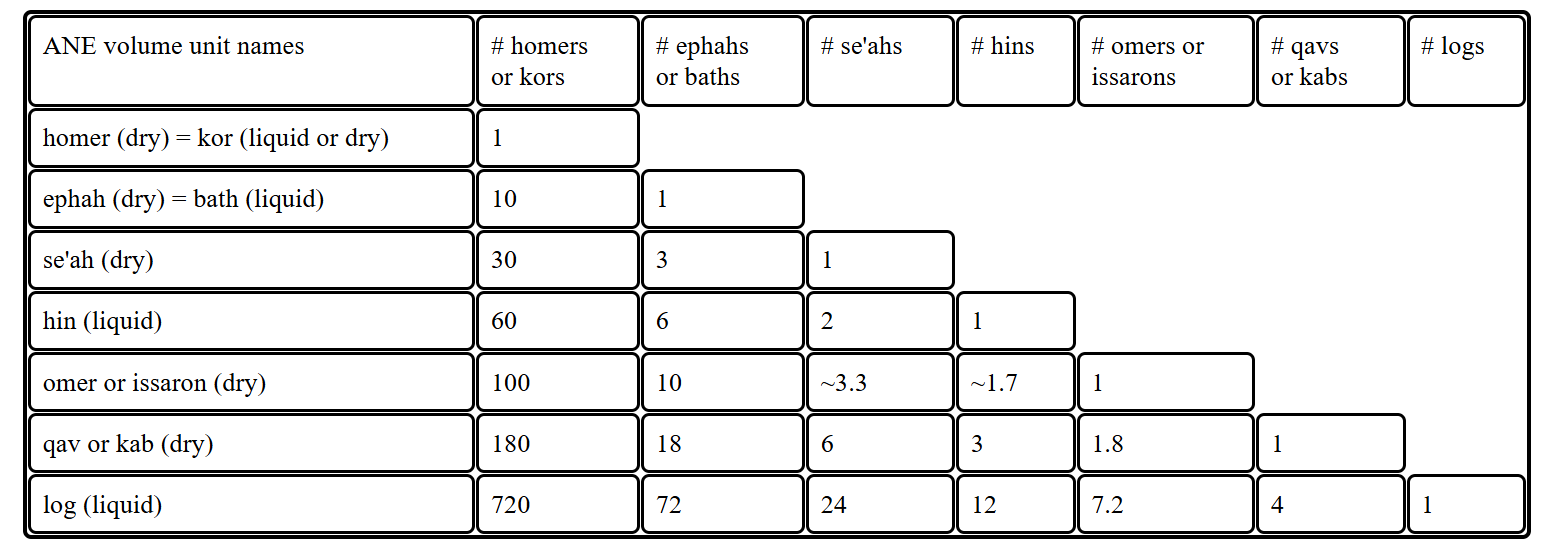
3. Chart (taken from Roland deVaux, Ancient Israel, vol. 1, p. 201 and Encyclopedia Judaica, vol. 16, p. 379)
II. Weight Terms Used Most Often
- The three most common weights are the talent, the shekel, and the gerah.
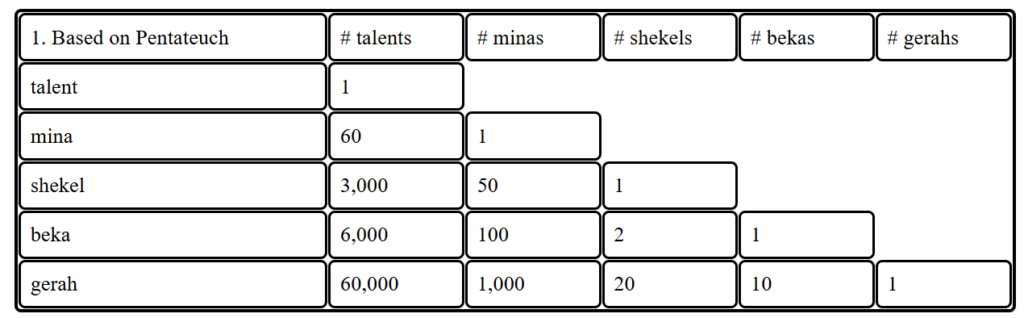
- The largest weight in the OT is the talent. From Exod. 38:25-26, we learn that one talent equals 3,000 shekels (i.e., “round weight,” BDB 503).
- The term shekel (BDB 1053, “weight”) is used so often that it is assumed, but not stated in the text. There are several values of shekel mentioned in the OT:
- “Commercial standard” (NASB of Gen. 23:16).
- “The shekel of the sanctuary” (NASB of Exod. 30:13).
- “By the king’s weight” (NASB of 2 Sam. 14:26), also called “royal weight” in the Elephantine papyri.
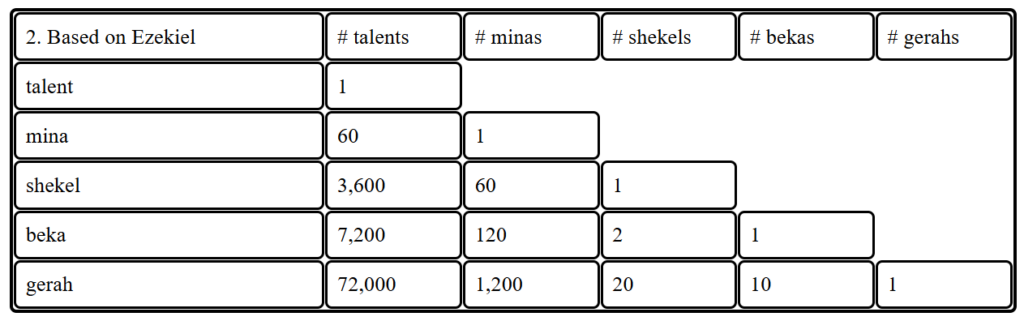
- The gerah (BDB 176 II) is valued at 20 per shekel (cf. Exod. 30:13; Lev. 27:25; Num. 3:47; 18:16; Ezek. 45:12). These ratios vary from Mesopotamia to Egypt. Israel followed the evaluation most common in Canaan (Ugarit).
- The mina (BDB 584) is valued at either 50 or 60 shekels. This term is found mostly in later OT books (i.e., Ezek. 45:12; Ezra 2:69; Neh. 7:71-72). Ezekiel used the 60-to-1 ratio, while Canaan used the 50-to-1 ratio.
- The beka (BDB 132, “half a shekel,” cf. Gen. 24:22) is used only twice in the OT (cf. Gen. 24:22; Exod. 38:26) and is valued at one-half a shekel. Its name means “to divide.”
III. Charts showing comparisons between various units of weight